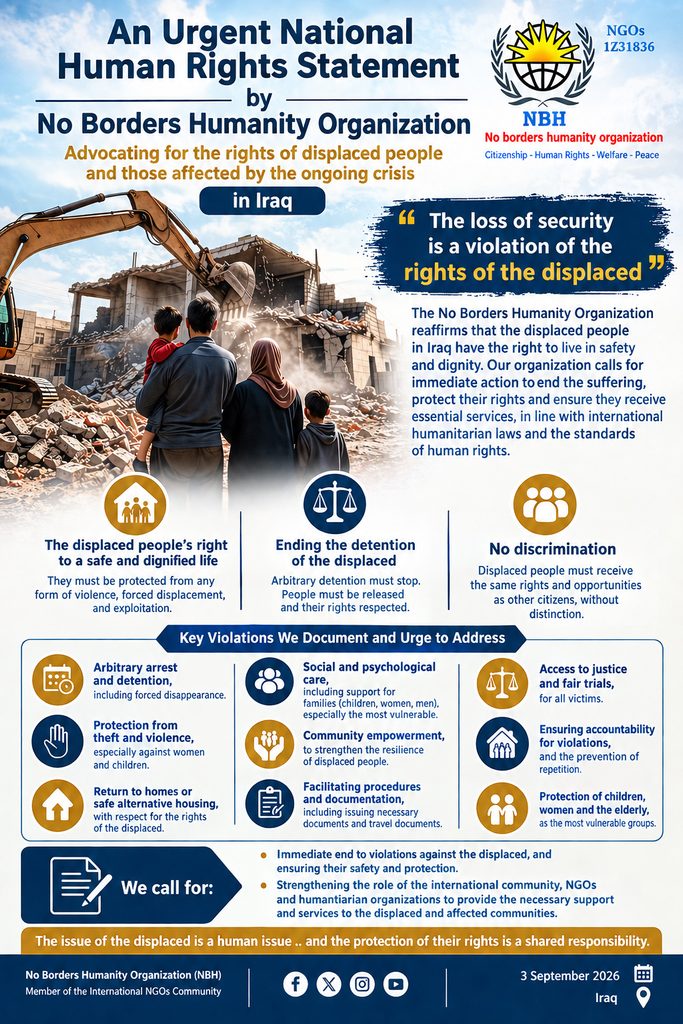
Urgent National Human Rights Statement
Concerning Procedures for the Eviction and Removal of Housing Units and the Regulation of Informal Occupation and Unregulated Construction in Iraq
“Enforcing the Law and Protecting Human Beings Are Two Interrelated Responsibilities.”
No Borders Humanity Organization (NBH)
An Iraqi non-governmental, non-profit, and non-political organization
Holding Consultative Status with the United Nations Economic and Social Council (ECOSOC)
No Borders Humanity Organization (NBH) is following with concern and close human rights and humanitarian attention the measures being undertaken in several Iraqi governorates to evict and remove houses and structures falling under cases of informal occupation, unregulated construction, or violations of land-use regulations, and the direct impact that some of these measures may have on families and individuals residing in such properties.
While the Organization reaffirms its respect for the rule of law, the right of the State and competent authorities to regulate land use, protect public and private property, and take lawful measures against cases of unlawful occupation or construction violations established in accordance with the law, it emphasizes at the same time that such measures must be implemented in accordance with legal, human rights, and humanitarian safeguards, while preserving human dignity and preventing homelessness or disproportionate harm to the most vulnerable groups.
First: Terminology and the Legal Status of Residents
The Organization emphasizes that describing all residents of housing units subject to removal measures as “encroachers” in a general manner may not necessarily reflect the legal status of each individual case.
The legal status of the land or building and the legal status of the individuals residing therein are two separate matters that must be independently verified through the competent legal procedures.
Accordingly, NBH uses terms such as “housing units or occupations subject to legal review” and “housing units subject to eviction or removal procedures,” without assigning a predetermined legal characterization to residents until the alleged violation and responsibility have been established in accordance with the law and by the competent authorities.
Second: No Objection to Law Enforcement — But Safeguards Must Be Ensured
No Borders Humanity Organization emphasizes that its position does not seek to obstruct the enforcement of the law or protect any unlawful occupation or illegal construction.
Rather, the Organization affirms that:
“Regulating land use, protecting public property, and enforcing laws are fundamental responsibilities of the State.”
However, law enforcement must be carried out through clear and fair procedures and must take into consideration the humanitarian consequences of eviction or demolition, particularly when the affected properties are the actual homes and shelters of families.
Therefore, establishing a violation concerning land or construction does not mean that the fundamental rights of persons affected by the measure cease to apply, nor does it exempt public authorities from observing legal safeguards and humanitarian considerations when implementing eviction or removal decisions.
Third: Housing, Shelter, and Human Dignity
The Organization considers shelter to be more than a physical structure. For a family, it represents a place of safety, stability, and protection.
When eviction or removal results in a family losing its shelter without an appropriate alternative or transitional arrangement, serious humanitarian and social consequences may arise, including homelessness, increased risks to children, disruption of education, increased poverty, and the loss of family and social stability.
Therefore, NBH calls for any removal or eviction measures to be carefully assessed, proportionate, and gradual, and to be preceded by an assessment of their anticipated social and humanitarian impacts.
Fourth: The Need for Individual Case Assessment
The Organization calls for housing units and families not to be treated as a single category. Instead, each case should be individually assessed, including:
- The legal status of the land, property, or construction.
- The nature and history of the occupation.
- The existence of any rights, documents, or pending legal applications.
- The family’s social and economic circumstances.
- The number of family members.
- The presence of children or older persons.
- The presence of persons with disabilities, medical conditions, or special needs.
- The family’s ability to secure alternative accommodation.
- The potential impact of eviction or removal.
This approach does not grant immunity to violations. Rather, it ensures procedural fairness and prevents fundamentally different cases from being treated identically.
Fifth: Safeguards to Be Observed Before Eviction or Removal
No Borders Humanity Organization calls upon the competent authorities, in accordance with the law, to observe essential safeguards, including:
- Providing persons concerned with prior and clear notice of the measure, its reasons, and the authority that issued it.
- Ensuring access to legal avenues for objection, grievance, or review before the competent authorities.
- Conducting a social and humanitarian assessment of cases where eviction may result in the loss of shelter.
- Giving priority to protection in cases involving children, persons with disabilities, older persons, or highly vulnerable families.
- Ensuring that procedures are not carried out in a manner that endangers the lives or safety of individuals.
- Protecting the personal belongings and property of families during the implementation of any lawful measure.
- Prohibiting humiliation, cruel or degrading treatment, and the use of force beyond the limits permitted by law.
- Providing transitional solutions or appropriate alternatives for cases where individuals are determined to face homelessness, subject to available government programs, resources, and applicable law.
- Considering options for settlement, regularization, reorganization, or resettlement where permitted by law and consistent with the public interest.
- Ensuring transparent documentation of eviction and removal operations and providing accessible complaint and review mechanisms.
Sixth: The Need for a National Policy
NBH believes that addressing informal housing in Iraq should not rely solely on removal measures. Rather, it should form part of an integrated national policy on housing, urban planning, and social protection.
The Organization calls upon the Federal Government and local authorities to examine the underlying causes that have contributed to the expansion of informal housing, including poverty, rising housing costs, population growth, urban expansion, shortages of affordable housing, and broader economic and social conditions.
Addressing the root causes of the problem is more sustainable than focusing solely on its consequences.
Seventh: Protecting the Most Vulnerable Groups
The Organization emphasizes that children and vulnerable groups must not bear disproportionate consequences because of the legal status of a property or construction.
Where families include children, female-headed households, older persons, persons with disabilities, or families without any other source of shelter, the competent authorities should take these circumstances into account when implementing any measure, in accordance with the law and humanitarian principles.
Eighth: The Role of Provincial Councils and Local Governments
NBH calls upon provincial councils and local governments to address this issue as a legal, social, humanitarian, and development issue at the same time.
The Organization also calls for regular dialogue with civil society organizations and human rights and humanitarian actors, and for making use of their expertise in monitoring, assessment, awareness-raising, and community mediation.
Ninth: The Role of Civil Society
No Borders Humanity Organization emphasizes that civil society organizations do not stand in opposition to State institutions. Rather, they play a complementary role in monitoring, advocacy, awareness-raising, promoting community participation, protecting rights, and providing recommendations.
Building on its experience in humanitarian, human rights, and community-based work, and as an Iraqi organization holding Consultative Status with the United Nations Economic and Social Council (ECOSOC), NBH declares its readiness to participate in relevant national and local dialogues, committees, and mechanisms within the applicable legal frameworks.
The Organization is also prepared to contribute to the development of social and humanitarian assessments, monitoring the impacts of eviction and removal operations, and providing practical recommendations that can assist competent authorities in achieving a balance between law enforcement and human protection.
Tenth: Demands of No Borders Humanity Organization
Based on the above, No Borders Humanity Organization calls for:
- Establishing a clear national framework for addressing informal occupations and unregulated construction.
- Avoiding general legal labels for residents without determining the legal status of each case through the competent procedures.
- Adopting individual legal and social assessments before implementing measures that may result in the loss of shelter.
- Guaranteeing the right to prior notice, objection, and grievance in accordance with the law.
- Protecting children and the most vulnerable groups from disproportionate impacts of eviction or removal.
- Providing appropriate alternatives or transitional solutions for cases where homelessness is likely to result.
- Considering settlement, regularization, or reorganization options where permitted by law.
- Ensuring respect for human dignity throughout all implementation procedures.
- Engaging civil society organizations and human rights and humanitarian actors in monitoring and follow-up.
- Moving from short-term procedural solutions toward a sustainable national policy for affordable housing, urban planning, and social protection.
Organization’s Message
No Borders Humanity Organization affirms:
“The rule of law is not incompatible with the protection of human rights. Rather, the strength of the law is demonstrated when it is applied fairly, through proper procedures, and in a manner that preserves human dignity.”
The Organization further emphasizes:
“Addressing the legal status of land or construction must not become a reason to disregard the humanitarian circumstances of the people affected by the measure.”
From this perspective, NBH stands with the rule of law and institutions, the protection of public property, and the proper regulation of cities and land — while at the same time standing for human dignity and protection from homelessness and inhumane treatment.
The objective is not to obstruct lawful procedures, but rather to ensure that their implementation is fair, proportionate, lawful, and humane.
No Borders Humanity Organization (NBH)
No Borders Humanity Organization
An Iraqi non-governmental – non-profit – non-political organization
ECOSOC Consultative Status – United Nations
Human Rights | Citizenship | Welfare | Peace
Republic of Iraq
3 September 2026